

Steve Rosenberg: Russia's economic forum overshadowed by drone attacks on St PetersburgShareSaveAdd as preferred on GoogleSteve RosenbergBBC Russia Editor

 Getty Images
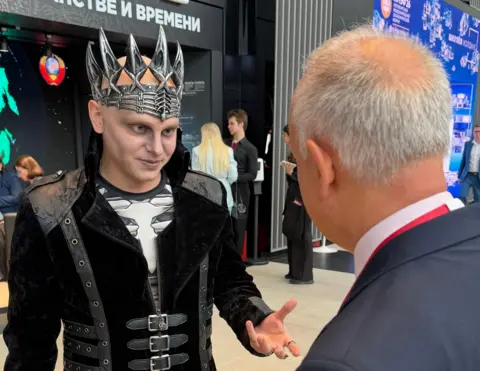
An evil sorcerer is the last person you'd expect to see at an economic forum.
But there he stood working his wizardry.
With sleight of hand Russian folklore villain "Koshchei the Deathless" (or, rather, someone dressed as him) produced coins out of thin air, "broke" and reassembled someone's glasses and shocked passers-by with occasional puffs of smoke from his fingers.
"Russians are unpredictable people," he declared. "We do things no one expects."
Perhaps.
But in St Petersburg this week, the unexpected was delivered most dramatically by Ukraine.
Ukrainian drones attacked the St Petersburg area on the opening – and closing – days of the set-piece International Economic Forum (SPIEF).
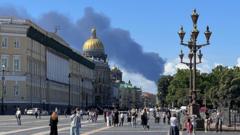
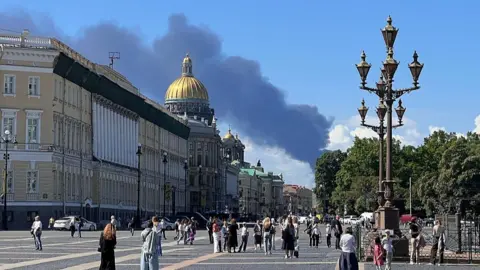
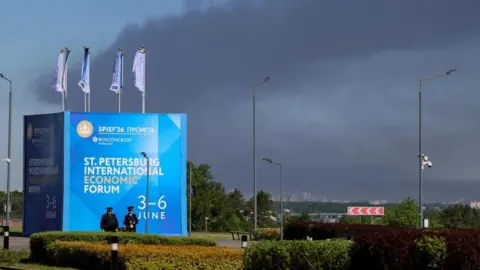
The abiding image of SPIEF 2026 will be the huge plume of thick black smoke which dominated the St Petersburg skyline on Wednesday. Without specifying what was hit, local officials admitted that drones had damaged "infrastructure". All the delegates saw the smoke as they arrived at the expo centre on the edge of the city.
Few could have predicted what came next.
Volodymyr Zelensky published an open letter to Vladimir Putin. Ukraine's president taunted Russia's leader about his age and about Russian setbacks in the war but proposed the two leaders meet in a neutral country to talk peace.
President Putin's response?
Nothing unpredictable about that.
The Kremlin leader, who had rejected previous calls for direct talks with President Zelensky, criticised the letter's "rude" tone and dismissed the offer.
"It's not the author of the letter I need to respond to," President Putin said, "but our soldiers on the frontline…I say to them: keep at it, brothers!"
Vladimir Putin is not ready to end Russia's war on Ukraine.
Not unless it's on his terms.
I listened to what he said at the forum's plenary session. There were few surprises.
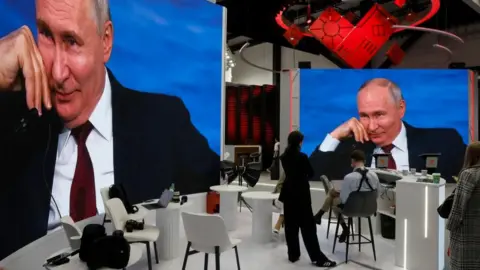
The Putin we saw is the Putin we expected to see – uncompromising, unrepentant, determined to project an image of strength and unwavering conviction. He tried to appear confident about the war, and about Russia's economy.
 EPA
EPA"There are wars and sanctions. But the economy is developing," Vladimir Putin claimed. "Everything is stable."
Applauded by entrepreneurs, friendly foreign dignitaries and officials, inside the congress hall the Russian president could style himself as a super strong leader.
His problem is what's happening outside.
The massive battlefield losses that Russia has suffered in its war on Ukraine.
The long-range Ukrainian drones now penetrating deep inside the country.
At the forum when I asked senior officials about the war, their responses had one thing in common: they quoted the Kremlin. A reminder, perhaps, of whose idea the so-called "special military operation" was in the first place.
"The war is in its fifth year," I pointed out to Alexander Zhukov, deputy speaker of the Duma, the lower house of Russia's parliament. "Do you think it will it end soon?"
"I can only respond in the words of our president. He said this situation must be resolved soon," replied the MP.
"Drones targeted St Petersburg this week," I reminded Vasily Anokhin, the governor of Smolensk region. "And your region too has in the past come under drone attack."
"As our president says," the governor began, "our enemies, unfortunately, are trying to hurt us."
The Russian economy is hurting. There are no signs of imminent collapse, but war and sanctions are creating considerable pressure. Growth has stalled in most sectors. Russian economists speak of "stagnation" and, in some areas, "decline". The ongoing conflict is sucking massive resources, both human and financial.
On a recent trip to Lipetsk region, small business owners told me they were struggling to stay afloat.
With its shiny stands and big-budget presentation the St Petersburg forum presented a more rose-tinted view of Russia's economy.
 Reuters
"Interest rates are a bit too high," conceded Kirill Dmitriev, President Putin's special envoy on foreign investment when we spoke at the forum.
"We believe rates should be lower for more investments. But Russia's economy has proved resilient over the last five years: something that many Western analysts believed was impossible."
Even in a challenging economic environment some businesses here spy an opportunity.
"A few years ago, Russians flocked abroad on holiday," businessman German Galperin told me, "but the situation doesn't always allow that now due to sanctions and because attitudes to Russians abroad have changed.
"That's prompting the development of modern tourist centres in Russia."
Unlike sorcerer "Koshchei the Deathless", the Kremlin cannot abracadabra coins out of thin air. It would certainly ease the budget deficit if it could.
It did, though, magic up some attention-grabbing guests for the forum.
"I do give a good hello from your friend President Trump," Rodney Mims Cook Jr told President Putin in St Petersburg. As chair of the US Commission of Fine Arts, Mr Mims Cook Jr is overseeing the controversial White House ballroom project.
Russia trumpeted his presence and claimed he was heading the first official US delegation at the St Petersburg forum in a decade.
But there was no fanfare from the US State Department.
"I am not aware of the delegation that went," US Secretary of State Marco Rubio said this week. "I'm aware of the event. I know they were hosting one, but I don't think it would have been a high-level official."
Walking round the exhibition halls at this year's SPIEF I noticed an eclectic mix: everything from boxing robots to singing, dancing grannies.
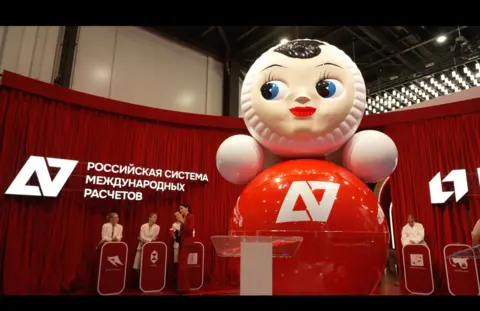
One of the most eye-catching installations was a ginormous Russian 'nevalyashka', or tumbler doll. As generations of Russian children know, the roly-poly 'nevalyashka' wobbles a lot, but never falls down.
I often think that's how the Russian authorities want the world to view their country: as a giant tumbler doll that cannot be knocked down or defeated, no matter how hard you push it. Despite more than four years of war, and battered by sanctions, Russia is still standing.
A defiant image? Certainly.
But perhaps not the best advert for attracting long term foreign investment.
For that, the fewer wobbles the better.
Vladimir PutinRussiaWar in UkraineUkraine